What they do and how
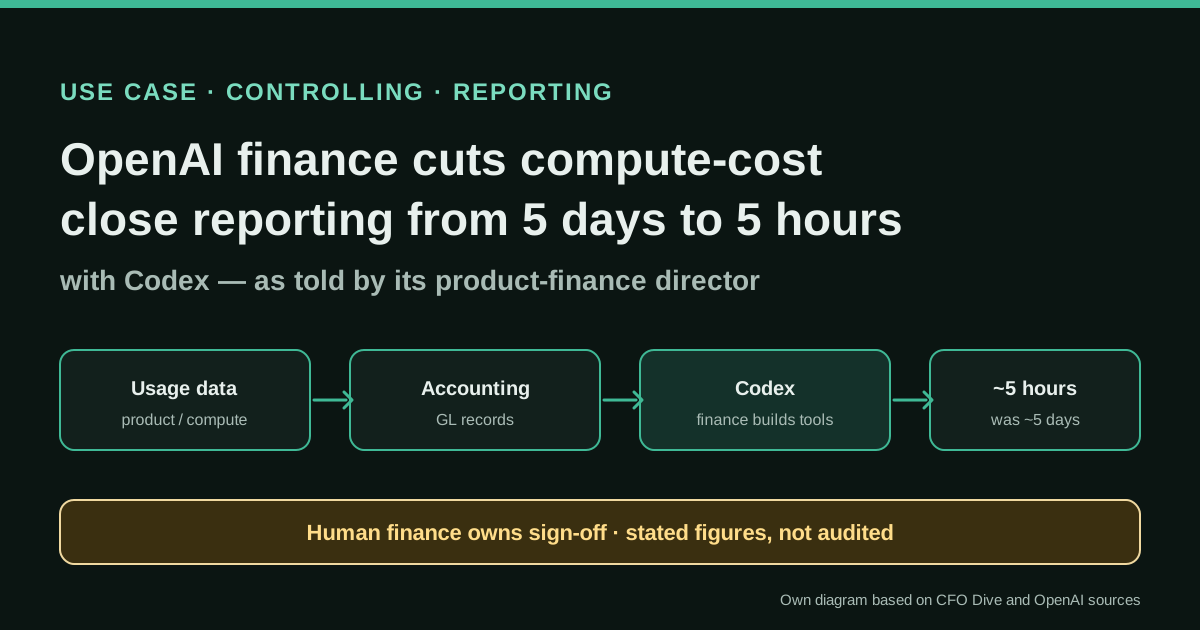
During the monthly close, OpenAI’s product-finance team must reconcile product-usage data with accounting records for computing capacity costs, then turn that reconciliation into analysis and reporting. Kyle Kober and colleagues used Codex so finance professionals could build automation for that workflow themselves, instead of waiting on engineering queues. The same organisation is redesigning close and forecasting around continuously reconciled data and live tools, with humans keeping final sign-off.
Reported result
Stated by Kyle Kober to CFO Dive (1 September 2026): the compute analysis process that was part of monthly-close reporting was cut from about five days to roughly five hours. Separately, Sarah Friar (10 August 2026) says the team is still building toward a zero-day close and continuous forecasting; she cites IR-GPT producing strong first drafts of investor diligence answers in seconds (work that previously took hours and sometimes overnight), with IR reading and owning the final answer. No independent audit of the time saving is published.
Stated figures. An identified person or organization states that they have used it. The results are stated by the source; we have not audited them.
What has really been tested
We checked the CFO Dive interview and OpenAI’s Friar blog on 18 October 2026. The sources name the people, the tools and the approximate before/after for one compute-cost workflow; they do not publish the scripts, the exact data sources, the volume of lines reconciled, how the five days vs five hours were measured, or screenshots. We have not reproduced the workflow. Codex and ChatGPT Work are commercial OpenAI products; treat stated results as company claims.
How to replicate it
Pick one painful, data-heavy close step (usage-to-ledger reconciliation, cost allocation, variance package). Map the files and systems, define checks a junior could run, give a coding agent read-only access to exports and a clear CLAUDE.md/SOP-style brief, keep every journal and board number under human approval, measure cycle time and exception rate before and after, and only then expand. Do not paste confidential ledgers into consumer chat tools without a company-approved workspace.
In two sentences
OpenAI’s director of product finance, Kyle Kober, told CFO Dive that his team used Codex to automate reconciliation of product-usage data with accounting records for computing capacity costs, cutting that monthly-close analysis from about five days to about five hours. The project sits inside CFO Sarah Friar’s public programme for an AI-native finance function aimed at a zero-day close and continuous forecasting; OpenAI sells the tools involved, and the figures are stated, not audited.
Who does it and why this process
OpenAI’s finance organisation grew around a company that itself scaled extremely fast. Friar wrote on 10 August 2026 that when she joined two years earlier the finance team was small, and closing the books and updating forecasts still meant a lot of manual, recurring work: finding information, explaining what changed and assembling inputs for decisions. The ambitions she set were explicit: a zero-day close (a real-time, reconciled, traceable view of the financial position) and automated, continuously updated forecasting. She is clear that the company is still building toward both.
Kober is director of product finance. His LinkedIn focus, as summarised by CFO Dive, is consolidating product-level forecasts across user metrics, revenue and compute demand. Before OpenAI he led product and corporate finance at Nextdoor and worked at Financial Technology Partners. The workflow he described to reporter Alexei Alexis (published 1 September 2026) is one of the most awkward pieces of that product-finance job: compute capacity costs.
Why start there?
- Two worlds of data. Product-usage / capacity data live outside classic accounting. The general ledger holds the costs that must be reported. Reconciling them is slow and error-prone when done by hand every month.
- It sits on the critical path of close. Until usage and accounting agree, analysis and reporting for that cost line cannot finish.
- Finance could not wait for engineering. Kober’s framing to CFO Dive is blunt: “There’s now the opportunity to just do it yourself.” Codex let product finance build targeted automation without sitting in a long development queue.
Keep the commercial context in view. OpenAI develops Codex and ChatGPT Work. Friar and Kober are describing internal use of products their employer sells. That does not make the testimony worthless — named people, a concrete workflow and a before/after are rarer than press-release fluff — but it does mean you should treat the numbers as stated by the company, not verified by an outsider.
Tools and architecture
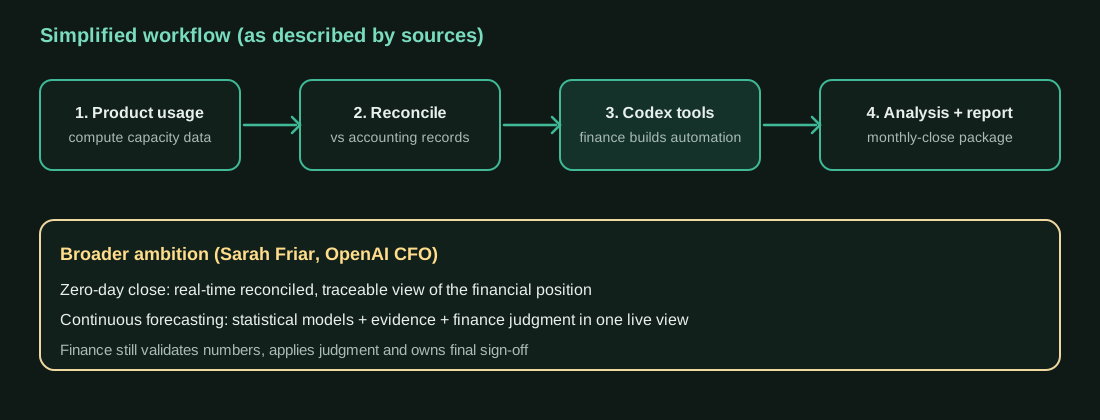
From the two primary sources, the stack looks like this:
- Operational / product data. Usage and compute-demand signals that product finance needs for capacity-cost analysis. The outlets do not name the warehouse or product-analytics systems.
- Accounting records. General-ledger and related books that must line up with usage before the cost story can be told.
- Codex as the builder. An AI coding agent that finance staff used to write and iterate the automation for reconciliation, analysis and reporting. Kober says most OpenAI engineers had their “Codex moment” around November or December of the prior year; finance followed a couple of months later. He started revamping the workflow with Codex before ChatGPT Work launched in July 2026.
- ChatGPT Work as a broader assistant. After launch, the finance team used both: ChatGPT Work for longer, multi-app tasks; Codex for the coding path that started with developers.
- Custom GPTs and live dashboards (org-wide pattern). Friar writes that everyone on her team is building custom AI dashboards and tools with ChatGPT Work and Codex. Examples she gives: IR-GPT (grounded in approved investor-relations materials for diligence questions), and custom GPTs for procurement and tax. One teammate who had never coded used Codex to turn a monthly advertising forecast into weekly and daily plans that stay tied to the approved model.
What the sources do not claim: that AI posts journals unsupervised, that the full close is already zero-day, or that compute-cost reporting is fully hands-off. Friar’s model is consistent: AI prepares and accelerates; finance validates, applies judgment and owns the final sign-off.
Step by step to replicate it (without OpenAI’s private systems)
You will not get OpenAI’s internal connectors. You can still copy the operating model: finance owns a painful close step, builds a thin tool with a coding agent, and keeps human control. The steps below are ours, based on what Kober and Friar describe plus common close practice — not a dump of OpenAI’s code.
1. Choose one close bottleneck with two data sources
Good candidates: usage-to-revenue reconciliation, cloud/compute cost allocation, prepaid or deferred revenue schedules, or any monthly package that today takes days of spreadsheet stitching. Write down:
- Source A (operational export) and Source B (GL / subledger).
- The join keys (customer id, SKU, cost centre, invoice id).
- Materiality thresholds and the list of exceptions that always need a human.
- Who signs the final package today.
2. Measure the baseline honestly
Before any agent: calendar time, active person-hours, number of exceptions, rework loops. Kober’s public claim is “about five days” to “roughly five hours” for one process. Without your own baseline you cannot know if a new tool helped.
3. Export, don’t grant write access on day one
Pull read-only CSVs or warehouse extracts into a locked working folder. Strip or mask personal data. Prefer a company-approved workspace (enterprise ChatGPT / Claude / Copilot with retention controls) over consumer chats. Codex-style agents should write scripts that run on your laptop or a controlled runner — not post to the ERP.
4. Write a short SOP the agent must follow every session
A one-page brief (many teams put this in a CLAUDE.md or project instructions file) should include file paths, column definitions, join logic, naming conventions, forbidden actions (“never invent a journal”, “never email externally”), and the exact output artefacts (reconciled table, exception list, commentary draft). Friar’s lesson on redesigning the full path from source data to decision applies here: if you only automate chart-making, you leave the scramble intact.
5. Let the agent build the pipeline; you own the controls
Ask the coding agent to produce:
- A reconciliation script with row counts and hash totals at each step.
- An exception report sorted by absolute and percentage variance.
- A draft narrative that cites line ids, not vague language.
- Unit checks (“sum of allocated cost must equal GL account X within €1”).
Then run the script yourself, compare to last month’s signed package, and only promote when the control totals match.
6. Keep approval where it already sits
Friar’s IR-GPT example is the right mental model for close: seconds for a strong first draft, humans still read, add judgment and check consistency. Same for compute-cost (or cloud-cost) analysis: the agent may draft the bridge from usage to ledger; a named controller or product-finance owner still signs.
7. Score the workflow the way Friar suggests
Her four questions for each AI workflow: Did AI complete work that mattered? What did it cost (including review and rework)? Was the result good enough to use? Did it help us move faster or make a better decision? For close she lists cycle time, share of transactions reconciled automatically, exceptions needing review, and time to explain a variance.
Concrete example (illustrative pattern, not OpenAI’s numbers)
Imagine a mid-market SaaS product-finance team with monthly cloud spend of several hundred thousand euros and usage metrics in a warehouse. Today, two analysts spend most of a week aligning SKU-level usage to GL cost centres, chasing missing tags and drafting the board appendix.
A Codex- or Claude Code-style loop might look like:
- Export
usage_by_sku.csvandgl_cloud_costs.csvafter soft close. - Agent writes a Python notebook that joins on
cost_centre+sku, allocates untagged spend by a documented rule, and writesexceptions.csv. - Agent drafts a one-page bridge: prior month, current month, price vs volume vs mix, and the ten largest exceptions with document ids.
- Product-finance lead spot-checks the top ten, fixes master-data tags, re-runs, and attaches the bridge to the close binder.
That pattern matches what Kober describes at a high level (reconcile usage with accounting, then analyse and report) without inventing OpenAI’s internal schemas.
Declared results and evidence level
| Claim | Who said it | Where | Evidence note |
|---|---|---|---|
| Compute analysis for monthly-close reporting cut from ~5 days to ~5 hours | Kyle Kober (OpenAI) | CFO Dive, 1 Sept 2026 | Company interview; method not published |
| Ambitions: zero-day close + continuous forecasting; still building | Sarah Friar (OpenAI CFO) | OpenAI blog, 10 Aug 2026 | Strategy, not a finished KPI |
| IR-GPT: strong first draft in seconds vs hours / overnight | Sarah Friar | Same blog | Qualitative; IR still owns the answer |
| Teammate with no coding background built ad-forecast daily/weekly tool with Codex | Sarah Friar | Same blog | Anecdote; no time study |
| Finance professionals’ specialised AI use: 40% outside traditional finance, 22% engineering-related | OpenAI research, cited by Friar | Same blog | Research summary; not a close KPI |
Evidence level for this directory entry: caso-real — identifiable organisation and named roles state results. Not an audit. OpenAI has a commercial interest in Codex and ChatGPT Work.
Limitations and risks
- Vendor narrative. Primary speakers work for the vendor of the tools. Prefer triangulation (here: Friar’s blog + Kober’s interview in a trade outlet).
- Scope. Five days to five hours is one compute-cost analysis step, not “the entire close”.
- Security and governance. A March Cloud Security Alliance paper, cited by CFO Dive, warns that organisations are putting AI-generated code into production while governance is still early. Finance scripts that touch money need review like any other critical automation.
- Token and cost risk. CFO Dive cites Gartner warnings that AI coding costs can rise with consumption-based pricing. Friar’s answer is to measure value per unit of intelligence, not seats alone, and to use usage limits and approval thresholds.
- Auditability. BCG, as summarised by CFO Dive, argues AI coding can let finance build matching and anomaly tools without waiting on IT — but only with clear auditability guardrails.
- Data leakage. Putting full ledgers and customer usage into an unapproved consumer model is a compliance failure waiting to happen.
Common mistakes
- Starting with “AI close” theatre instead of one painful reconciliation with two clean exports.
- Letting the agent post or email before a human has signed the control totals.
- Skipping the baseline, then celebrating a vibes-based speed-up.
- Feeding messy, unnamed columns and expecting Codex to invent business logic.
- Confusing draft narratives with management conclusions — the “why” still needs someone who knows the business.
- Copying OpenAI’s tool names without copying Friar’s accountability model (source-linked outputs, finance authorisation for baseline changes).
Conclusions
The useful lesson from OpenAI’s public finance story is not “buy Codex because OpenAI uses it”. It is that product finance can treat a coding agent as a way to build the missing glue between usage systems and the ledger, on a workflow that already has clear owners and materiality rules. Kober’s stated result — about five days down to about five hours on compute-cost close analysis — is specific enough to study and modest enough to sound like a real process, not a slogan. Friar’s wider frame (zero-day close, continuous forecast, humans owning sign-off, measure ROI per workflow) is what keeps that speed from becoming uncontrolled automation.
If you run controlling or product finance elsewhere, replicate the shape: one bottleneck, two data sources, read-only exports, agent-built scripts with control totals, human sign-off, and a scorecard. Leave the brand names optional.
Sources (checked 18 October 2026, Atlantic/Canary)
Sources
- CFO Dive — Inside OpenAI’s experiment with AI coding in finance (Alexei Alexis, 1 Sept 2026) (opens in a new tab) (primary)
- OpenAI — What building an AI-native finance function taught me (Sarah Friar, 10 Aug 2026) (opens in a new tab)
- CFO Dive — OpenAI CFO touts move toward ‘zero-day close’ (coverage of Friar’s blog) (opens in a new tab)
- Boston Consulting Group — referenced in CFO Dive on AI coding agents for finance (June report, as cited by CFO Dive) (opens in a new tab)
We wrote this entry in our own words from the sources above and checked that the links worked on October 18, 2026. Is anything incorrect? Tell us.