What they do and how
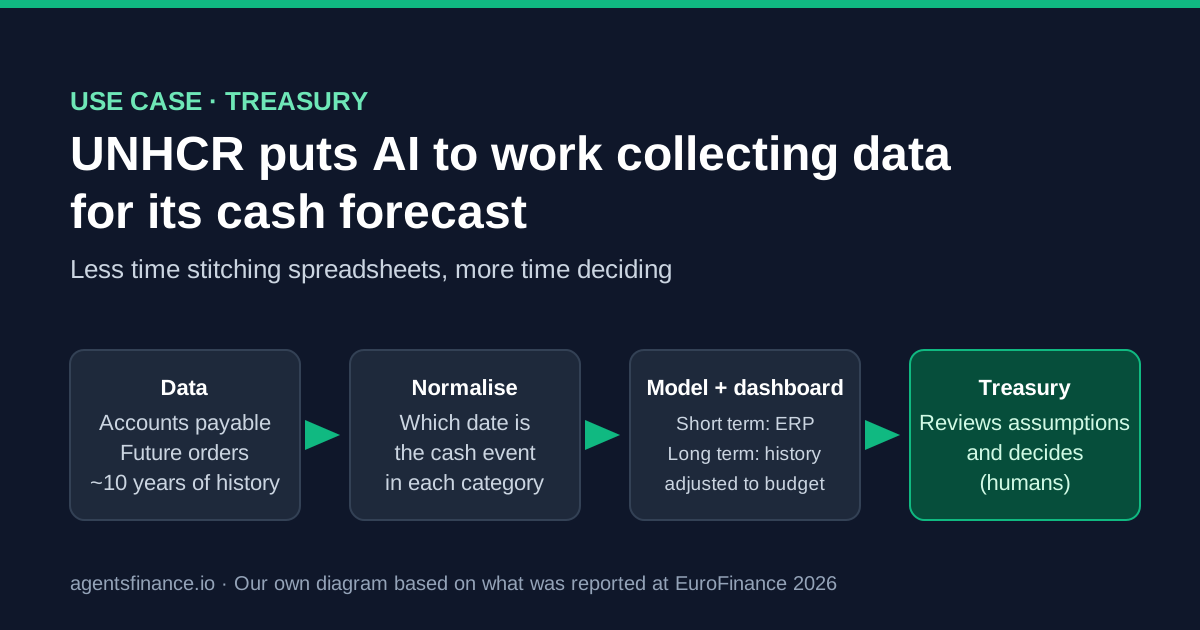
UNHCR's treasury team stopped pulling data from several systems into spreadsheets by hand for its cash forecast. With UNICC it mapped the main cash flow drivers (accounts payable, future-dated orders), brought in almost ten years of history, agreed which date represents the cash event in each category and built a forecasting layer that combines current ERP commitments in the short term with budget-adjusted historical patterns in the long term, plus scenario assumptions. The presentation (charts and tables) is generated automatically. For a while the AI forecast ran in parallel with the manual one and both were compared with actuals. Treasurers still review the output and decide.
Reported result
According to Kozuki, once the model is stable the work of collecting and consolidating data could fall by 40% to 60%; this is an estimate, not a published measurement. He states that they already spend less time collecting and normalising data, that the automatic dashboard reduces the effort of preparing charts and tables, and that the conversation with management has shifted from debating spreadsheets to debating assumptions. The process is not yet fully automated and some data still requires human intervention. No forecast accuracy metrics are published.
Stated figures. An identified person or organization states that they have used it. The results are stated by the source; we have not audited them.
What has really been tested
UNHCR uses it in its treasury according to its head, who described it at an industry conference; it is reported by EuroFinance, the event's organiser. The model type, code, error metrics and cost are not published. We have not reproduced the system and have no access to its data; the steps to replicate it in this article are our own adaptation of the lessons the source gives.
How to replicate it
Start with the decision you want to improve (short-term liquidity, timing of FX purchases, investments), not with the technology. Run a small pilot with reliable, high-impact data. Before touching any model, write a data dictionary: cash flow categories, which date rules in each, how currencies and restricted funds are treated, and who owns each field. Use ERP commitments for the short term and history for the long term. Run the automatic forecast in parallel with the manual one for several cycles and compare both with actuals. Automate the dashboard and leave review and decision with the treasury team.
Context: why a humanitarian agency needed a different way to forecast its cash
Treasury forecasting is one of the processes where the gap between what AI promises and what actually works shows most. That is why a case told in detail by the person who runs it deserves attention: the treasury unit of UNHCR, the UN Refugee Agency. Hikaru Kozuki, senior treasury specialist and head of that unit, explained it at the EuroFinance International Treasury Management 2026 conference, and EuroFinance published the summary on 16 September 2026.
The starting point is familiar to any treasurer. The team collected information by hand from different source systems, consolidated it in spreadsheets and then validated and adjusted it. Kozuki sums it up with a question: why were they spending so much time collecting data instead of analysing the result of the forecast? By the time the number was ready, the reality it was meant to reflect could have changed. In a humanitarian organisation, he recalls, the situation does not wait.
Two pressures were added to that. Since mid-2025, changes in donor support and budget cuts made history a less reliable guide for anticipating cash needs. And UNHCR’s headcount had shrunk without the workload falling in the same proportion. The forecast had to take into account future-dated transactions, historical trends, seasonality, currencies and changes in the operating environment: too many variables to keep going with a manual process.
This is not a project that starts from zero. According to an earlier EuroFinance article, in September 2023 UNHCR modernised its treasury management systems and bank connectivity and integrated them with its cloud ERP and the Digital Hub of Treasury Solutions (DHoTS), a treasury platform shared by several UN agencies with technical support from UNICC. That base of integrated data is what makes the next step possible.
Who does it and with what
- Protagonist: UNHCR’s treasury unit, with Kozuki as head and spokesperson for the case.
- Technology partner: the United Nations International Computing Centre (UNICC), which already managed bank, payroll, supplier payment and donor receipt information for UNHCR. That prior relationship settled much of the concern about data security.
- Data: accounts payable, future-dated purchase orders and almost ten years of history, plus scenario assumptions.
- Output: a cash forecast and an automatic dashboard with the charts and tables for management.
- What the source does not say: which type of AI model is used (statistical, machine learning or a language model), which tools it is built with, how much it cost or what forecast error it has. It is best not to fill those gaps with assumptions.
How they built it, step by step
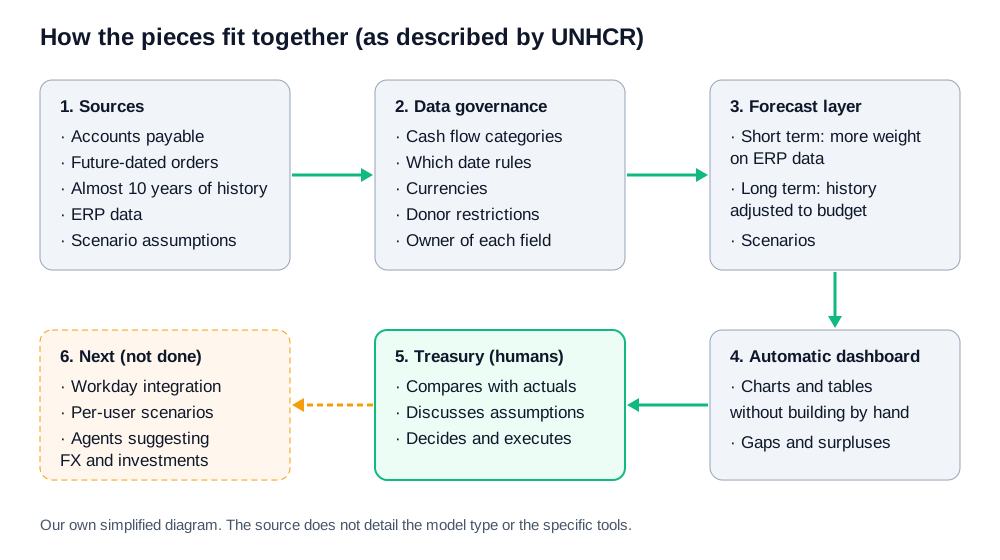
The order matters as much as the pieces. Kozuki describes a deliberately iterative process in several phases.
1. Map the cash drivers and their sources
The work started with the data, not the model. The team identified the main cash flow drivers (among them accounts payable and future-dated purchase orders) and which system each one came from. Treasurers took part from the beginning: they helped define which questions the forecast had to answer, which cash flow categories were relevant and what level of accuracy was needed.
2. Normalise: decide which date is the cash event
This is where the most interesting problem in the case appeared. The different systems did not describe the same fact in the same way. A single transaction could have an approval date, an accounting date, a payment date, a date of receipt by the payee and a bank reconciliation date, and any of them could be used to place the cash movement in time.
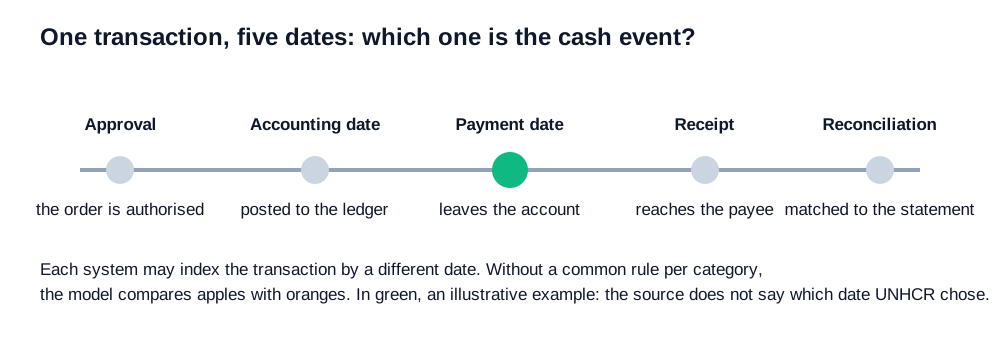
To compare, in Kozuki’s words, apples with apples, the project became partly an exercise in data governance: deciding which fields mattered, setting common definitions and establishing which date represented the real cash event in each category.
3. Build the forecasting layer and automate the presentation
The resulting model combines current information with historical patterns. For the short term it leans more on ERP data, which is reliable because it reflects commitments already made; for the long term it uses historical trends adjusted to the budget conditions of the moment, plus scenario assumptions. The team also wanted the presentation to produce itself: instead of finishing the analysis and then building charts and dashboards by hand, the aim was to join collection, forecasting and visualisation in a single flow.
4. Run in parallel and earn trust
The biggest difficulty, according to Kozuki, was not convincing anyone that AI could process data, but getting treasurers to trust the result. “It can’t be a black box,” he says: the team has to understand how the model arrives at its figures because it is the one explaining them to management. That is why, for a while, the AI forecast coexisted with the manual one. The team compared both with actual data and saw where the model was more or less accurate. Responsibility remained human: AI produces the forecast, but treasurers review it and decide.
A concrete example for your team
The most replicable part of the case is not the model but the data dictionary that comes first. This table is an illustrative example of how a mid-sized treasury team might start; it is not UNHCR data.
| Cash flow category | Source system | Date that rules | Horizon where it is used | Data owner |
|---|---|---|---|---|
| Supplier payments | ERP, accounts payable | Scheduled payment date | 0–13 weeks | Accounts payable manager |
| Approved purchase orders | ERP, purchasing | Scheduled payment date according to terms | 4–26 weeks | Purchasing |
| Payroll | Payroll system | Bank debit date | Whole horizon | Human resources |
| Customer or donor receipts | ERP, accounts receivable | Bank value date | 0–13 weeks with data, then history | Collections manager |
| Taxes | Tax calendar | Bank debit date | Whole horizon | Tax |
With that table agreed, the first pilot can be limited to two or three categories with clean data and a single currency, as Kozuki himself recommends when he says that today he would start with something smaller.
How to replicate it in your company
These steps are our adaptation of the lessons the source gives; they do not describe UNHCR’s internal system.
- Choose the decision before the tool. Kozuki insists that AI is only a tool: first you need to know which decision you want to improve (short-term liquidity, timing of FX transactions, level of investments). That determines which data, which model and which controls you need.
- Take an inventory of cash drivers. For each category, note which system it comes from, how often it is updated and how good its quality is.
- Write the data dictionary before modelling. What counts as a forecastable flow, which date rules, how you treat currencies, how you record restricted funds and who answers for each field. It is what Kozuki says he would do even earlier if he started today.
- Separate horizons. Use ERP commitments (registered invoices, approved orders) for the short term and adjusted history for the long term. Do not ask the model to guess what you already know.
- Start with methods you can explain. A case from the same source illustrates it: at ASML, according to EuroFinance, the team tested twenty open-source Python algorithms against five years of actuals and retrains the model every month with a person reviewing its performance. What matters is not the algorithm but being able to explain why the result is what it is.
- Run in parallel for several cycles. Keep the manual forecast while you compare both with actuals. Measure error by category and horizon, not just in total.
- Automate the presentation. A dashboard that updates itself frees up time even if the model is not perfect.
- Leave the decision and execution in human hands. UNHCR is exploring agents that suggest when to buy or sell currencies or place investments, but the transactions would be executed by people.
Stated results and their source
| Item | What is stated | Type of data | Source |
|---|---|---|---|
| Work of collecting and consolidating data | Could fall by 40% to 60% once the model is stable | Estimate by the head of the unit | EuroFinance, September 2026 |
| Preparation of charts and tables | Less effort thanks to the automatic dashboard | Qualitative statement | EuroFinance, September 2026 |
| Use of the team’s time | Less time collecting and normalising, more analysing | Qualitative statement | EuroFinance, September 2026 |
| Forecast accuracy | Not published | — | — |
Kozuki stresses that the goal is not a perfect forecast but to make good decisions easier under uncertainty. According to him, seeing possible liquidity gaps and surpluses earlier helps decide precautionary balances and investment levels, and the conversation with management now centres on assumptions: which donor receipts are firm, which payments could be delayed and where risks appear.
Limitations and risks
- Evidence: it is a real case, but told by its protagonist at a conference and summarised by the organiser. There are no audited figures or error metrics.
- Incomplete process: the source acknowledges that it is not fully automated and that some data still needs human intervention.
- Dependence on context: UNHCR already had integrated treasury systems, almost ten years of history and a trusted technology partner. Without that base, the data effort will be larger.
- Less reliable history: the case itself arises because the 2025 funding changes made the past a worse predictor of the future. A model based on history needs scenario assumptions and human review.
- Connection cost: Kozuki points out that the main brake on integrating further with the ERP, including Workday, is the budget for connection costs, not technical capacity.
- Data security: treasury data is sensitive. UNHCR solved it by relying on a partner that already held it; other companies will have to go through IT security, as Cloud Software Group describes in the EuroFinance article on ASML.
Common mistakes this case helps avoid
- Starting with the model. Without common definitions, AI amplifies inconsistency instead of resolving it, Kozuki warns.
- Mixing dates. Using the accounting date in one category and the payment date in another produces timing gaps that look like model errors.
- Covering the whole organisation at once. A narrow pilot shows value sooner and builds trust.
- Dropping the manual forecast too soon. Without a comparison period against actuals you will not know where the model fails.
- Expecting AI to decide. In this case AI gathers, processes and presents; interpreting uncertainty and deciding remains the treasurers’ job.
Conclusions
The UNHCR case is valuable precisely because it is unspectacular. It does not promise an autonomous treasury: it shows that the biggest job is putting the data in order, agreeing which date rules and earning the team’s trust with a parallel period. AI comes afterwards, to remove hours of collection and build the dashboard, and leaves treasurers the part that really adds value: discussing assumptions and deciding. If you want to replicate it, the first deliverable is not a model but a table of definitions and a small pilot.
Sources
- EuroFinance — From the floor at EuroFinance 2026: UNHCR asks AI to do the work behind the cash forecast (opens in a new tab) (primary)
- EuroFinance — Streamlining treasury operations: UNHCR's move towards integrated financial and treasury management solutions (opens in a new tab)
- UNICC — Digital Hub of Treasury Solutions (DHoTS) (opens in a new tab)
- EuroFinance — How two treasurers automated cash management (ASML and Cloud Software Group) (opens in a new tab)
We wrote this entry in our own words from the sources above and checked that the links worked on October 17, 2026. Is anything incorrect? Tell us.